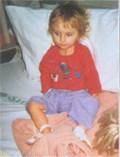
 - it's what everyone
does there so it was really
easy to organise.
- it's what everyone
does there so it was really
easy to organise.
|
Junior Magazine article (November 2002) |
Text Joanna Moorhead Photography Tricia de Courcy Ling
Imagine your baby had colic: she'd cry and cry, sometimes all night long. In your heart you felt something was wrong. But every health visitor you consulted reassured you, saying she was OK, that it was just how babies were, that she'd grow out of it. |
Then imagine finding out, a few months later, that your instincts were correct: that your baby's 'colic' was anything but normal. Imagine being told that the reason your baby had been crying her heart out was because her heart was giving up on her. Her worst bouts of crying had been due to a series of heart attacks: these had damaged the heart muscle to such an extent that your baby now needed urgent surgical repair.
For Corinna Schell, that was the nightmare scenario that confronted her during a holiday to her native Germany in April 2001. Her daughter, Nia, was by then 10 months old. Although she wasn't crying to the same extent that she had in her early months, Nia still wasn't thriving.
"The main thing we noticed was that Nia was really slow at gaining weight," says Corinna. 'And she wasn't moving around the way other babies of her age seemed to. She wasn't sitting up or crawling, and she wouldn't even roll over.
"My husband John and I had talked about our worries, and we'd taken her to see endless health visitors in the UK and everyone told us she was fine.
"But when I was in Germany
staying with my family I thought I'd put my mind at rest by taking her to see a paediatrician for a routine
check-up - it's what everyone
does there so it was really
easy to organise.
"I just picked a doctor out of the phone book at random. As she examined Nia, the doctor seemed to become more and more concerned. But it was when she listened to Nia's heart that her concern obviously grew, but she didn't say a word. At this point I knew something was seriously wrong. "
Corinna took Nia to a heart specialist immediately for an echocardiogram, an ultrasound test which uses high-pitched sound waves to see the heart and its structure.
"The doctor was silent throughout the test," remembers Corinna. "At the end he told me to get Nia dressed again. By the time we rejoined him in his office, he'd already arranged for Nia to be seen at a heart unit 80 miles away. He said we should go there straight away: I asked if we could go home for some clothes and he said no, we should just drive straight to the hospital. If Nia had the condition he suspected, she'd need urgent surgery."
Still reeling from shock, Corinna and her mother took Nia to the hospital, only to be told, to Corinna's horror, that they had to leave Nia on her own on the children's ward. "I couldn't believe they were telling me I had to leave Nia on her own," she says. "In Britain parents are always allowed to stay with their baby, but in Germany it's quite common for small children to be in hospital alone. I knew I couldn't leave Nia: I simply refused to go and they let me stay with her."
The following day Nia underwent an angiogram, a test in which dye is injected into the blood system to show how the blood is flowing through the heart. As doctors had feared, Nia had Anomalous Left Coronary from the Pulmonary Artery (ALCAPA see below) and her heart was being starved of the oxygen-rich blood it needed. She had already had several heart attacks which had damaged the heart muscle. One doctor told Corinna later that many children with ALCAPA, who were diagnosed as late as Nia had been, could only be treated with a heart transplant. Thankfully for Nia, though, surgery was possible.
"The doctors told us that Nia's case was so urgent she needed surgery the very
next day," says Corinna. "It was a terrible thing to hear. Until that moment
I'd hoped it might just be minor surgery, but it was clear this was a very
serious situation. I was in a state of total shock and complete exhaustion. I
was still wearing the clothes I had on the night before and I'd had no sleep.
I had left home the day before for a routine check-up as a precaution. Yet
here I was, a day later, being told my daughter might die, and being asked to
sign a consent form for long and complicated heart surgery."
It was a tough moment, but for Corinna and John the worst was still to come: handing their precious child over to surgeons at the operating theatre door. "As we went down to the theatre Nia was holding onto my hair and that's something she'd never done before, though she does it all the time now," says Corinna. "It's as though she knew something serious was going on and she didn't want to be taken away from me. Giving her to the doctors was the most difficult thing we've ever had to do, but we knew we had to do it. Without the operation, Nia wouldn't stand a chance."
Being ushered into the intensive care unit to see their daughter again after the operation was also tremendously difficult. "Nia had gone into the theatre a perfectly normal little baby," says Corinna. "Now we were seeing her on a ventilator, with tubes coming out of her body, a continuous bleeping sound from all the monitors. She looked almost like a machine herself.
"It was a horrific sight, but the only thought in my mind was, she's still alive. I just clung on to that. My worst fear during the operation was that that they'd tell us she had died."
"Nia went into the operating theatre a perfectly normal little baby. Now we were seeing her on a ventilator, with tubes coming out of her body, a continuous bleeping sound from all the monitors. She looked like a machine herself." |
What Corinna didn't realise at the time was that it was the first 48 hours after surgery which would be crucial. "That was the critical period," she says. "Each minute seemed like hours as we got through those all-important days, but in the end it became clear Nia had turned a corner and was improving." One of the things Corinna found hardest to deal with, though, was the fact that, despite the severity of Nia's condition, she and John still weren't allowed to be with her all the time. "We weren't encouraged to be by her bedside for long periods of time, although we found it very hard to drag ourselves away. I was convinced that Nia needed us to be near her as much as we needed to be with her," she says.
Another problem was that it was difficult for Corinna and John to get a full explanation of what had happened during Nia's operation, until they found out the shocking news that the planned repair surgery hadn't been possible after all. Instead the doctors had tried an experimental by-pass to re-route the blood supply and so solve the problem that way.
"It sounded scary, but at least it seemed to be
working and Nia seemed to be improving," says Corinna.
A few weeks later Nia was discharged, and the family made their way back to
their home in Milton Keynes. Their German surgeon had put them in touch with a
heart specialist at the Birmingham Children's Hospital. However, their first
consultation brought yet more devastating news. "The consultant said he thought
the by-pass done in Germany hadn't worked. Nia's heart, which had been twice its
normal size before the operation, was still enlarged, and the mitral valve was
still leaking badly. To our dismay, the doctor told us more surgery was the only
solution, but he couldn't tell us what Nia's chances of survival were because
her condition was so rare.
"Nia's heart, which had been twice its normal size before the operation, was still enlarged. More surgery was the only solution but the doctor couldn't tell us what Nia's chances of survival were because her condition was so rare." |
"I couldn't believe we were facing this nightmare again so
soon, but our doctor persuaded us to go through with it. Again, it seemed like
Nia's only chance. This time we were allowed to carry her right into the
operating theatre and to stay with her while she went to sleep," says Corinna.
"While she was in surgery we just wandered aimlessly around Birmingham, not
knowing or caring where we were or what we were doing. When we went back to the
hospital in the evening the doctor was waiting for us, looking very sombre, and
I thought it was going to be terrible news. Thankfully, Nia had come through the
operation very well.
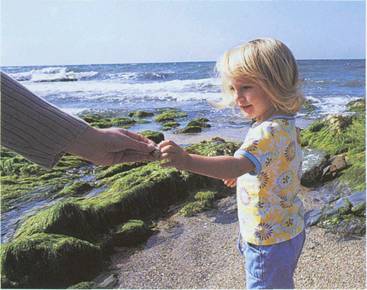 "This
time Nia's recovery was very different. We were with her all the time, and she
was put into my arms for a cuddle just eight hours after her operation. Everyone
was so kind and understanding. We felt as though we were part of the team caring
for Nia, and that the doctors and nurses were caring for us as well as for her.
I'm sure it's no coincidence that Nia recovered really quickly, and although
there were bad days as well as good ones, she went from strength to strength."
"This
time Nia's recovery was very different. We were with her all the time, and she
was put into my arms for a cuddle just eight hours after her operation. Everyone
was so kind and understanding. We felt as though we were part of the team caring
for Nia, and that the doctors and nurses were caring for us as well as for her.
I'm sure it's no coincidence that Nia recovered really quickly, and although
there were bad days as well as good ones, she went from strength to strength."
Just three weeks after her surgery, you'd hardly know Nia was am different from any other 19-month-old child. Today she's just turned two - her second birthday gave her parents the opportunity for a party they wouldn't have dared contemplate a year ago. "Then we were just grateful she was still alive. Now we have a little girl who is lively and energetic and goes to nursery and plays with her friends. Some days it seems like a miracle.
"Of course we'll never know exactly what the future holds for Nia, which is why we're so committed to enjoying every minute we have together. The doctors have told us they simply don't know what will happen in the months and years ahead: Nia could need more surgery, or she could be absolutely fine. The worst-case scenario is that she 'II need a heart transplant, but we don't dwell on that. We really do live for the moment.
"To us Nia is a hero. She went through such tough times and she survived. She's full of life, love and happiness. For our family, even day is a celebration of that."
The facts about ALCAPA and other congenital heart diseasesAnomalous Left Coronary from the Pulmonary Artery (ALCAPA) is very rare affecting only around a quarter to half a per cent of children with heart conditions. It occurs when the main coronary artery originates from the pulmonary artery instead of the aorta, which means the heart doesn't get the correct amount of oxygen it needs. This means the heart has to work a lot harder to do its job, which in turn makes it weaker and reduces the amount of oxygenated blood it is able to pump to the other organs of the body such as the muscles, skin and digestive system. Most children with ALCAPA are diagnosed in the early months of life because their symptoms are so severe. In cases like Nia's where they are older, a child will often have suffered one or more heart attacks because the strain on their heart has been so great. Treatment involves complex surgery in which cardiologists
try to reconnect the heart vessels so the system works normally. If ALCAPA is
not treated, nine in ten affected babies die by the age of 12 months. Many of these conditions are due to the fact that the heart's complex 'plumbing system' of arteries, veins and valves have not been properly connected when the baby's circulatory system was forming in the early weeks in the womb. Other conditions, though, are due to problems with the heart's rhythm or because the pumping action doesn't work properly. Babies with CHD are often diagnosed when doctors discover a 'murmur' during a routine heart check with a stethoscope - often this murmur is 'innocent', but sometimes it is problematic and the child has to be referred to a heart unit for further tests and treatment. Babies with heart conditions are often diagnosed because they seem different from other babies: their skin may have a slightly bluish tinge (cyanosis) because not enough red, or oxygenated, blood is getting to their skin. They may also be breathless or sweat a lot because their system is being overloaded by the normal demands of eating and moving. Feeding problems are another sign of a heart condition (although, feeding problems are extremely common in babies and are usually completely unconnected to heart disease). Babies with heart disease may also fail to put on weight. |